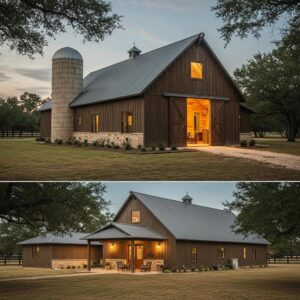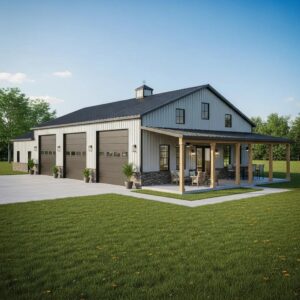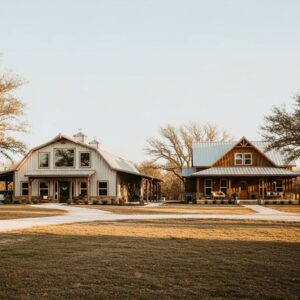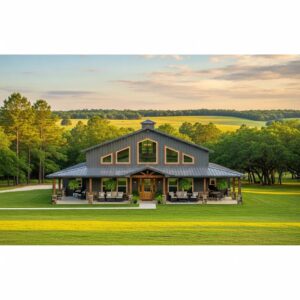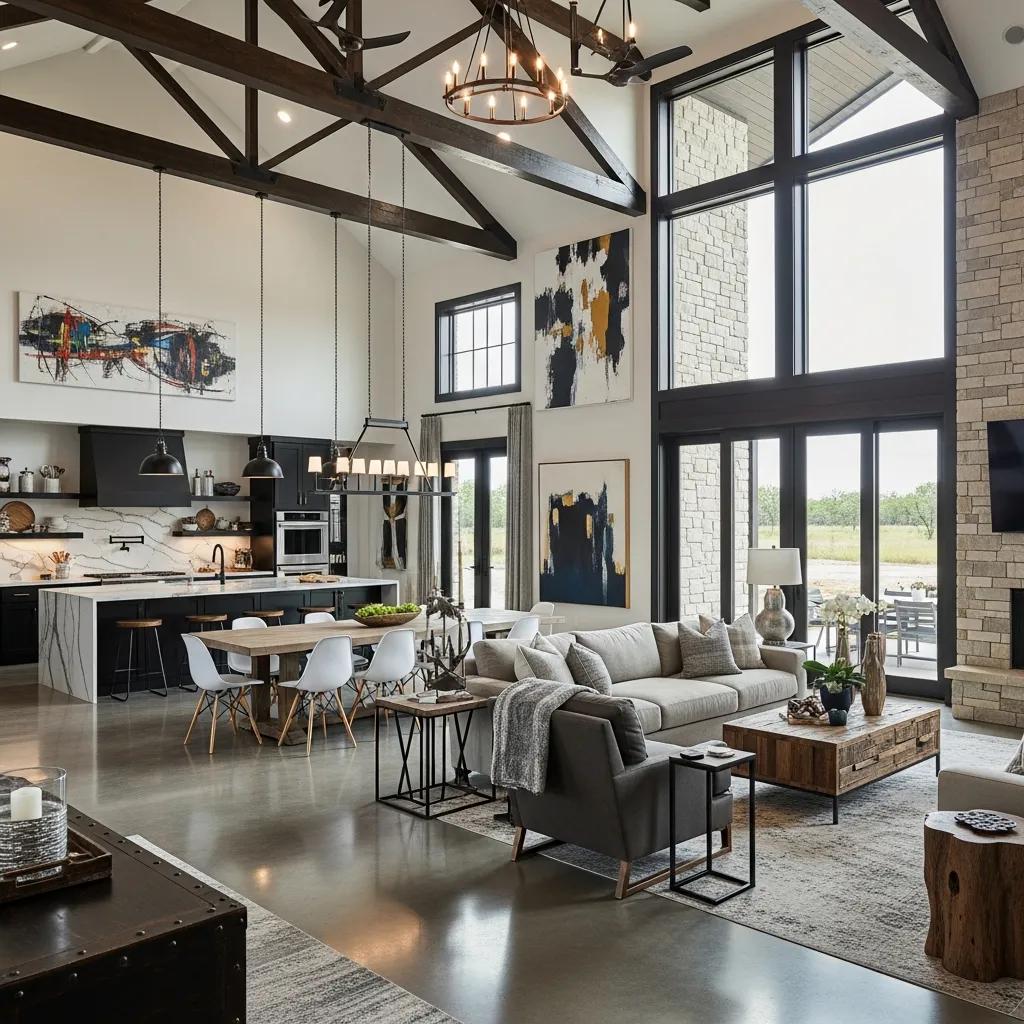
Open-concept barndominium floor plans for spacious, modern East Texas living
Open-concept barndominiums pair the practical strength of barn-style steel or post-frame shells with large, connected interior volumes that feel roomy and work harder for everyday life. This guide shows how vaulted ceilings, well-placed glazing, and clear circulation create both the perception and reality of space — with specific steps for families, retirees, and multi‑generational households across East Texas. You’ll get the design logic behind ceiling and window choices, zoning strategies that protect privacy, regional features like wraparound porches and attached shops, and the 2024 trends shaping steel-frame and smart-home adoption. Practical checklists, comparison tables, and EAV (Entity–Attribute–Value) tables make trade-offs easy to review so you can set priorities for your build. When you’re ready, a local drafting and build partner can turn these concepts into permit-ready CAD plans and a turnkey project — see the next steps for requesting plans or a consultation.
What are open-concept barndominium floor plans — and why they work
An open-concept barndominium groups main living functions — kitchen, dining, and living — into one flowing volume to maximize usable space, daylight, and social connection. The spatial effect comes from removing interior barriers, adding vertical continuity (vaulted or cathedral ceilings), and opening large glazed connections to the outdoors. The biggest payoff is flexibility: furniture and circulation can shift as family needs change, supporting entertaining, caregiving, or remote work without moving walls. Open plans also simplify movement for older adults by reducing thresholds and improving sightlines, which helps supervision and accessibility. These core benefits shape the practical design choices we explain below.
Open plans do come with trade-offs — mainly acoustics and privacy — but designers manage these with smart zoning and finish choices. Here are the primary advantages to aim for when planning an open-concept barndo.
Key benefits of open-concept barndominiums:
- Stronger social connection through uninterrupted sightlines and shared activity areas for cooking, dining, and relaxing.
- Better natural light and ventilation using larger windows and sliding doors that brighten deep interior spaces.
- Flexible use of space for home offices, guest sleeping, or entertainment without reconfiguring walls.
- Easier circulation and accessibility for retirees and multi‑generational households by reducing barriers and steps.
These benefits guide decisions about ceiling height, window placement, and how you balance shared versus private wings — which we break down next.
How an open-concept layout actually creates more usable space
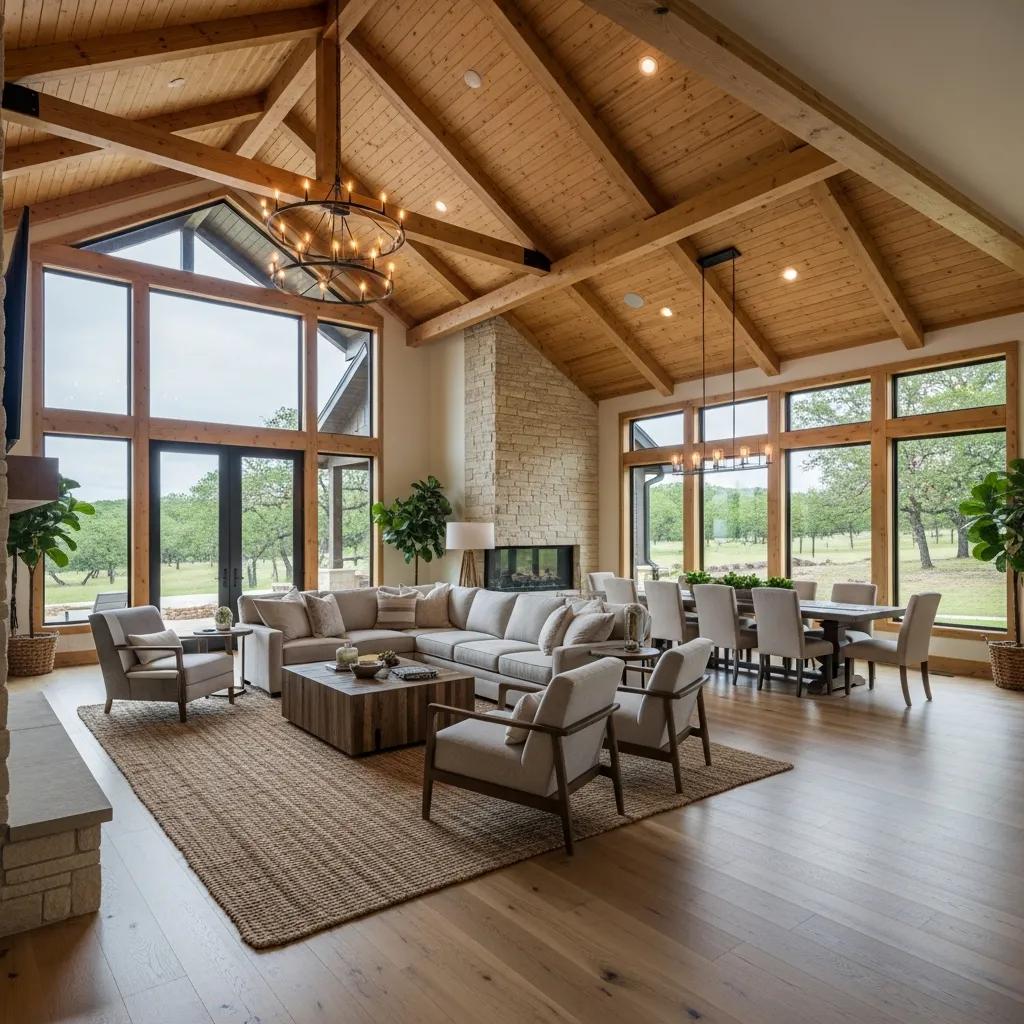
Open plans make a home feel larger by eliminating partition walls and creating continuous floor and sightline volumes. Continuous flooring and aligned openings let the eye move from one zone to the next, while vaulted ceilings and clerestory windows lift the vertical field of view and increase perceived volume. In everyday use — for example, someone cooking while others gather on the porch — this layout preserves connection without crowding. For homeowners with mobility concerns, fewer barriers mean smoother movement and easier supervision. The result is both psychological (less confinement) and functional (clear circulation and adaptable furnishing). Below we translate this into actionable design tactics like ceiling types and glazing strategies.
Why open-concept suits modern barndominiums
Barndominiums are structurally well suited to open-concept plans because steel framing or wide-span trusses can carry long spans without interior bearing walls. That freedom lets you create a single, large great room with lofts or mezzanines and an industrial-modern look that pairs well with rustic finishes. Buyers often value these light-filled, flexible spaces, and they make future reconfiguration simpler. Open plans do require attention to acoustics and mechanical zoning, so common mitigations include partial screens, area rugs, and zoned HVAC.
Understanding those trade-offs helps homeowners prioritize which open-plan features matter most for their lifestyle. Next we cover the design moves that make open plans comfortable and practical.
How to design a spacious barndominium that feels comfortable all year
Start with a few deliberate moves: raise the ceiling in the main living area, align large windows and sliding doors for daylight and cross ventilation, and place private rooms on a separate wing. The combination of vertical and horizontal continuity — vaulted ceilings for volume and continuous flooring and aligned openings for visual flow — makes the plan read larger and function better than a compartmentalized layout. The outcome is a home that supports entertaining, multi‑generational use, and single‑level living without giving up privacy. Below are practical steps to apply these principles.
Begin your layout with these priorities:
- Prioritize ceiling height: Use vaulted or cathedral ceilings in the great room to boost perceived space and allow clerestory daylight.
- Optimize glazing and orientation: Place large windows and sliders to capture morning or afternoon light while using shading strategies for East Texas heat.
- Define functional zones: Position kitchen, dining, and living so sightlines connect but bedrooms are tucked into a separate wing.
- Plan HVAC and acoustics: Zone mechanical systems and add soft finishes or partial screens to manage sound in open areas.
This checklist covers the essentials; next we compare common ceiling and window choices and their real impacts.
| Feature | Typical Specification | Effect on Space & Performance |
|---|---|---|
| Vaulted ceiling | 12–16 ft peak in great room | Boosts perceived volume and allows clerestory daylight |
| Clerestory/clerestory windows | High horizontal windows above sightline | Brings diffuse light without direct glare |
| Large sliding glass doors | 8–12 ft wide panels | Improves indoor–outdoor flow and cross-ventilation |
| Continuous flooring | Same finish across main zones | Unifies spaces visually and eases movement |
Use this quick comparison when choosing ceiling and glazing strategies — next we go deeper into how vaulted ceilings and windows perform in East Texas.
What vaulted ceilings and large windows do for interiors
Vaulted ceilings add a taller vertical plane, immediately increasing perceived volume and allowing clerestory windows to push daylight deep into the plan. Taller ceilings shift sightlines upward and reduce reliance on artificial light during the day. In East Texas, balance vaulted volumes with shaded glazing and good insulation to limit heat gain; common pairings include overhangs, operable windows for ventilation, and high-performance insulation. For families and retirees, this combination creates bright, accessible interiors that stay comfortable when designed with thermal performance in mind.
How flexible, multi-functional spaces add long-term value
Flex spaces let rooms serve more than one role — guest room/office hybrids, Murphy beds, lofts for play or storage — so the house adapts as needs change. Flexibility comes from modular elements: movable partitions, built-in storage, and convertible furniture let a single footprint support sleeping, working, and leisure. Typical examples are a great room with a recessed guest alcove or a garage wing that doubles as a workshop and craft studio. For multi‑generational living, separate wings and private entries preserve autonomy while shared areas stay spacious. These strategies guide furniture, partition, and circulation choices so openness and privacy can coexist.
Which custom features define modern East Texas barndominiums?
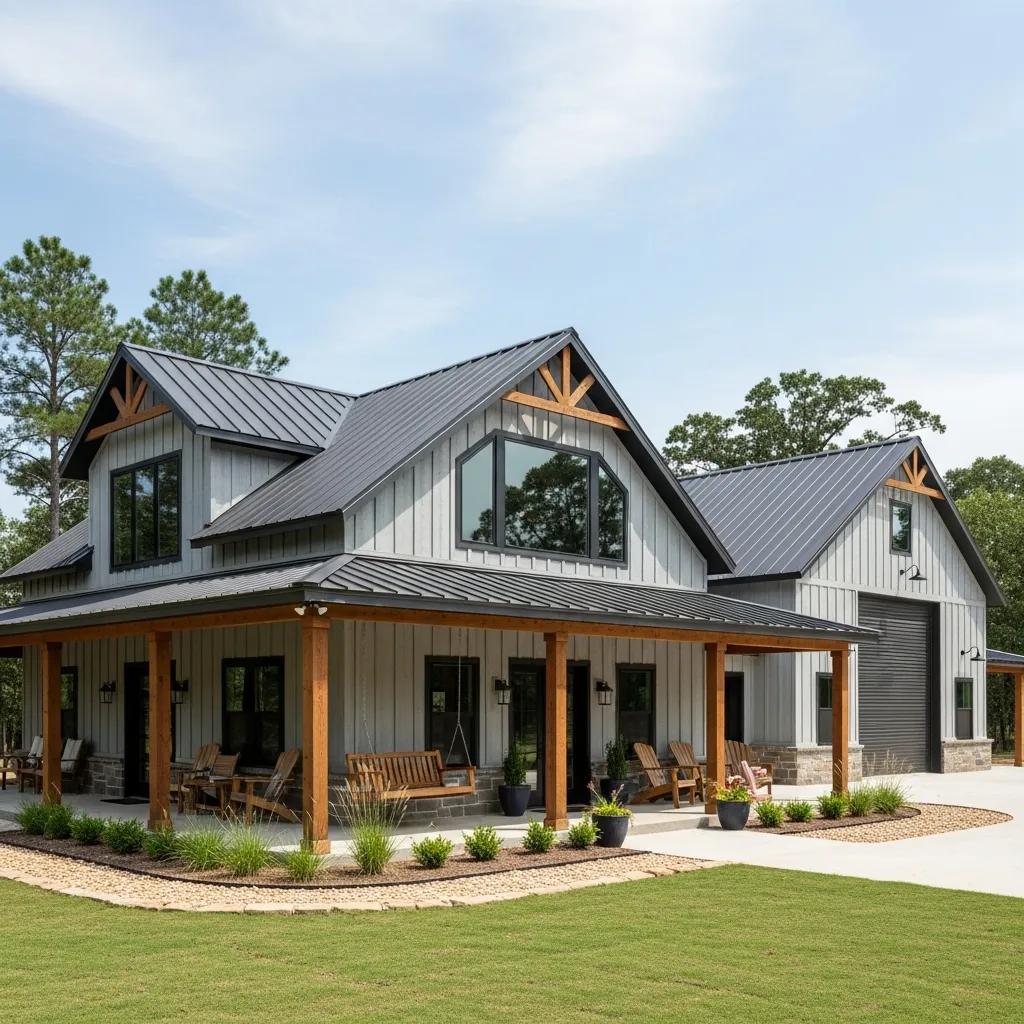
In East Texas, modern barndominiums commonly combine attached shops, generous porches, and private master wings with energy-efficient envelopes and smart systems. The real source of value is functional adjacency: placing a shop or garage next to living areas makes hobbies and storage convenient, while wraparound porches extend living outdoors and provide passive cooling.
These elements boost daily life and resale, but their size, orientation, and systems should match client priorities — workshop needs, accessibility, or multi-generational use. Below are the core features homeowners ask for most.
Popular custom features:
- Attached shop/garage: Secure, practical workspace for tools, vehicles, and projects.
- Wraparound porch: Outdoor living that shades walls and improves indoor–outdoor flow.
- Private master suite: A separated wing for privacy and single-level convenience.
- Energy-efficient envelope: High R-values or spray foam insulation paired with zoned HVAC.
- Smart-home readiness: Pre-wired controls for thermostats, lighting, and security.
Use the EAV table below to compare typical sizes, attributes, and the value each feature delivers.
Feature comparison: typical size, common attributes, and the everyday value they provide.
| Feature | Typical Size/Attribute | Value |
|---|---|---|
| Attached Shop | 400–1,200 sq ft | Workshop space, secure storage, hobby flexibility |
| Wraparound Porch | 8–12 ft depth continuous | Outdoor living, shading, higher curb appeal |
| Master Suite Wing | 300–600 sq ft | Privacy, accessibility, in‑law potential |
| Energy Envelope | High R-values, spray foam option | Lower energy bills, more consistent comfort |
| Smart Systems | Thermostat, lighting, security wiring | Convenience, remote control, better energy management |
This EAV view helps you prioritize features that deliver the most value per square foot. Next we look at how shops, porches, and master wings add practical and resale benefits.
How attached shops, porches, and master suites raise value
Attached shops give secure, conditioned workspace for hobbies, small business activities, and vehicle work — one of the most useful additions for hands-on homeowners. Wraparound porches create shaded outdoor rooms that reduce solar gain and add usable space during temperate months. Master suites in a private wing improve single‑level living and appeal to buyers seeking accessibility and separation from the main activity areas. Together these features fit regional living patterns — outdoor life and workshop culture — and offer flexible spaces future owners will appreciate.
After weighing features, many clients ask for plan options that match their workshop needs and porch orientation. Energy and smart systems then complete the picture.
Which energy-efficiency and smart-home technologies should I consider?
Energy-efficient envelopes and smart systems improve comfort and lower operating costs in open plans through sealed construction, zoned HVAC, and intelligent controls tuned to large volumes.
The benefit comes from integrated systems: a well-insulated shell reduces heat transfer while smart thermostats and zoning let you control temperature separately in the great room and sleeping wings, which is especially important in open plans.
Common options include high-performance insulation, solar-ready framing, energy recovery ventilators, and smart thermostats that learn occupant patterns. In East Texas, effective shading and efficient glazing are key to managing cooling loads.
Together, these elements raise comfort, reduce utility costs, and support long-term sustainability for owners and future buyers.
Who builds barndominiums in East Texas — and what does the process look like?
Local barndominium projects generally follow a clear sequence: initial concept and budget discussions, schematic drafts and 3D models, permit-ready CAD plans, permitting and contractor coordination, construction, and a final walkthrough for turnkey handover.
This process works because each stage sharpens decisions and aligns design with site constraints and local codes so the finished home matches expectations.
What sets providers apart is in-house drafting, 3D visualization for client review, and turnkey options that manage subcontractors and inspections. Knowing the standard process helps you plan timelines and decision points. Below is a compact breakdown of how a local drafting partner handles open-concept projects.
The typical build process:
- Initial consultation: Define goals, budget, and site constraints.
- Schematic design & 3D modeling: Produce early plans and renderings for review.
- Permit-ready drafting: Prepare detailed CAD plans for permits and construction.
- Construction & coordination: Manage the build, inspections, and subcontractors through completion.
Clear steps make responsibilities and deliverables obvious — next we show how a local drafting partner customizes plans and guides the journey from idea to turnkey handover.
How Ross Homes & Drafting, LLC customizes open-concept barndominiums
Ross Homes & Drafting, LLC works collaboratively using CAD and 3D visualization to test layouts, ceiling profiles, and glazing strategies before producing permit-ready plans. That lets you see and tweak design choices early, avoiding surprises later.
Common custom options include varied shop footprints, alternate porch layouts, and master suite configurations that keep single-level living convenient.
To request plan options or talk through a custom design, contact Travis Ross at travis@rossdrafting.com or (936) 671-0652. For in-person consultations, the local office is at 209 Pinto Drive North, Hemphill, TX 75948.
From collaborative drafting we move into permit production and construction coordination.
Steps from drafting to turnkey construction
The path from drafting to turnkey handover follows clear milestones that define deliverables and timelines so homeowners know what to expect at each stage.
- Initial consultation and site assessment to establish program needs and budget.
- Schematic designs and 3D models reviewed and revised until approved.
- Permit-ready CAD plans produced and submitted for local approvals.
- Construction begins with contractor coordination, milestone inspections, and progress updates.
- Final walkthrough and punch-list items complete the turnkey handover.
Timeframes vary with permit cycles and project complexity, but timely decisions on finishes and selections help keep things moving. Clear milestone definitions reduce delays and align expectations between homeowners and their builder.
2024 trends in open-concept barndominium floor plans
For 2024, buyers and designers favor multi-generational flexibility, stronger indoor–outdoor flow, steel-frame solutions for long spans, and energy-ready smart-home systems that lower operating costs.
These trends are driven by lifestyle value: people want adaptable homes that support aging‑in‑place, remote work, and outdoor living, while keeping maintenance and energy use low.
Design responses include winged plans, covered outdoor rooms, pre-wired smart systems, and steel framing to allow wide-open interiors without intermediate supports.
Below are the most common 2024 trends and what they mean for your plan.
- Multi-generational layouts: Separate wings and flexible suites for privacy and shared caregiving.
- Indoor–outdoor integration: Large sliders and covered porches that expand living space and control solar exposure.
- Steel framing for long spans: Durable structures that enable expansive great rooms.
- Smart, energy-ready homes: Pre-wiring and infrastructure for thermostats, solar readiness, and remote monitoring.
These trends help future-proof homes for resale and changing family needs; the next section explains layout patterns that support multi-generational households and seamless outdoor connections.
How multi-generational living and indoor–outdoor flow are incorporated
Multi-generational plans typically use separate sleeping wings or accessory suites with living amenities and private entrances while keeping a central great room for shared time. The idea is spatial separation paired with communal zones: private wings provide autonomy and the great room remains the family hub.
Indoor–outdoor flow relies on oversized sliders, covered porches, and aligned sightlines so outdoor rooms act as living extensions. Solutions often include accessible circulation, dual-entry mudrooms, and adaptable suite layouts that shift between guest and long-term use.
These patterns balance privacy and connection for households with different routines and needs.
Why steel framing is popular for durability and design flexibility
Steel framing is growing in popularity because it supports long spans and slim members that create wide-open interiors, lofted spaces, and a modern industrial aesthetic. Structurally, steel carries loads efficiently so fewer interior supports are needed, producing flexible plans and clean sightlines ideal for open designs. Steel is also resilient to pests and decay and performs predictably under load, which appeals to owners who want low maintenance and long-term durability.
Costs and availability vary locally, so designers weigh steel’s initial premium against lifecycle durability and design freedom when recommending it for open-concept barndominiums.
The advancements in steel have been a key enabler of the expansive, open designs now common in modern barndominiums.
Steel advancements for long-span structures
Recent developments in steel have pushed building dimensions and spans significantly higher. Improvements in steel products, fabrication, and construction methods are major drivers behind this progress — enabling longer, taller structures with predictable performance and easier maintenance.
| House Size | Bedrooms | Typical Range |
|---|---|---|
| Small family | 2–3 | 1,200–1,800 sq ft |
| Standard family | 3–4 | 2,000–2,400 sq ft |
| Multi-generational | 4–5 | 2,400–3,200 sq ft |
Use these quick ranges when estimating size and bedroom counts during your initial consultation.
For personalized drafting, permit-ready plans, and turnkey coordination tailored to East Texas or Louisiana sites, contact travis@rossdrafting.com or (936) 671-0652 to schedule a consultation or request sample 3D plans and a project estimate.
Frequently asked questions
What should I consider when choosing materials for a barndominium?
Choose materials for durability, insulation value, and the look you want. Steel framing offers strength and longevity; wood delivers warmth and a traditional feel. Insulation is critical in East Texas — prioritize high R-values or spray foam to control temperature swings. Also pick materials that support an open plan: large, efficient windows for daylight and continuous flooring to keep visual flow. Always account for local climate and maintenance needs when deciding.
How can I make my barndominium energy efficient?
Focus on a tight, well-insulated envelope, energy-efficient windows, and zoned HVAC. High R-value insulation and careful sealing reduce heat transfer. Consider solar-ready roof framing and smart thermostats to manage usage. Strategic window placement maximizes daylight while minimizing unwanted heat gain. Regular system maintenance keeps efficiency high over time.
What advantages do smart-home systems bring to a barndominium?
Smart systems add convenience, security, and better energy control. Smart thermostats learn schedules and optimize heating and cooling. Remote-monitored security systems provide peace of mind. Smart lighting saves energy and sets mood easily. These features enhance everyday living and can boost resale appeal to tech-minded buyers.
How do I choose the right layout for my family?
Start with how you live: number of occupants, privacy needs, and likely future changes. Open plans work great for social living, while separate wings give privacy. Think about uses — home office, guest space, play areas — and plan for flexibility. A design professional can translate your needs into a layout that fits your lifestyle and budget.
What common mistakes should I avoid when designing a barndominium?
Avoid underestimating natural light, neglecting storage, and failing to plan for future needs. Make sure windows are placed to bring daylight into deep spaces. Include built-in storage to reduce clutter. Think ahead for aging-in-place or remote work needs. Working with experienced designers helps you skip these common missteps.
How can I add outdoor living to my barndominium design?
Outdoor living boosts daily enjoyment and usable space. Add wraparound porches, patios, or an outdoor kitchen to extend living areas. Use large sliders for seamless indoor–outdoor transitions and plan shaded areas for comfort in hot months. These elements raise livability and curb appeal, making the home great for gatherings and relaxing outdoors.